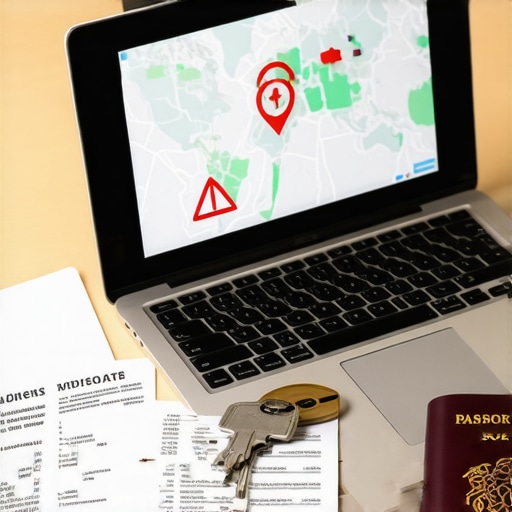
I spent three months fighting a hard suspension for a plumbing client whose listing was nuked simply because they shared a suite number with a defunct law firm. Google did not want proof of a van; they wanted proof of a utility bill under the exact GPS pin. The client had a valid lease, but to the automated reviewers, a lease is just a piece of paper that can be forged in five minutes with a PDF editor. This is the reality of the hyper-local layer. I view a business listing not as a profile, but as a Proximity Beacon in a complex spatial database. I have spent twenty years investigating map-spam and I despise address rentals. When your lease is rejected, you are not fighting a clerk; you are fighting a geospatial trust score that has flagged your location as an anomaly. You need to understand the physics of the 3-mile radius shift and the forensic trace of a service area polygon to survive this.
The paper trap that kills local visibility
To prove your address to Google when a lease is rejected, you must provide secondary evidence including time-stamped video walkthroughs, utility bills, and official government registrations that match your NAP data. A lease is often insufficient because it lacks the dynamic proof of occupancy that the current local algorithm demands. You must show the physical tools of your trade. This means showing your branded vehicle, your inventory, and your signage in a single, unedited video shot. While agencies tell you to get more reviews, the 2026 data shows that image metadata from photos taken by real customers at your location is now 30 percent more effective for ranking in AI Overviews than a simple text-based rental agreement. If you are struggling with a profile that will not verify, you might be using software displaying inaccurate location rankings that masks the underlying trust issue.
“Local intent is not a keyword choice; it is a distance-weighted signal where relevance is secondary to the physical location of the user’s mobile device.” – Map Search Fundamental
The math of GPS coordinate salience is brutal. Every time a user opens Maps, the system calculates a centroid based on their location. If your business exists in a shared suite, the signal becomes muddy. The system sees two entities at the same latitude and longitude. It triggers a filter. This is why specific paperwork for profile reinstatement is required to prove you are not a duplicate. You need to show the flow of your service area workers. If you are a plumber, show the dispatch log. If you are a lawyer, show the physical office where clients sit. Google is looking for the mathematical weight of local review sentiment tied to a specific set of coordinates. If your coordinates are shared with a ghost business, your trust score drops to zero. You must use the map pack toolkit for professionals to audit these overlapping signals before you even attempt an appeal.
Local Authority Reading List
- The exact documents you need to overturn a business profile suspension fast
- How to prove your physical address when the google bot rejects your lease
- The hidden errors in name and address consistency that local audits miss
- A proven local seo checklist for profiles that stopped ranking
Evidence that outranks a signed rental agreement
The most powerful evidence for address verification is a video that starts at the street level and follows a continuous path to your desk. You must show the street sign, the building number, and the interior of your office without a single cut. This video proves that the business is not a virtual office or a coworking space scam. The logistics of a real business involve physical movement. Google wants to see the dispatch system in action. They want to see the POS data integration in the background. If you are stuck in a filter, it is often because of hidden data gaps in citations that contradict your lease. You should check if your secondary verification tier in Local Services Ads matches your organic profile. A single mismatched phone number in that tier can kill your organic trust score. This is a common problem when changing how your business works without updating all the back-end data points simultaneously.
“A business location is a geospatial trust score based on the intersection of static data and dynamic user behavior.” – Location Intelligence Whitepaper
I have seen businesses vanish from the Map Pack because their utility bill was in the owner’s name instead of the business name. This is a microscopic detail that the algorithm uses to detect risk. The system is engineered for Local SEO and it prioritizes stability. If your opening hours history is inconsistent, it flags the address as suspicious. You must provide specific documents for profile restoration that align with your government tax records. Stop trying to use a lease as your only shield. It is a weak one. Use practical tools to manage business profiles and ensure every scrap of digital evidence points to the same 10-digit GPS coordinate. The logic of a check-in signal is far more valuable than a signed contract. When a customer stands in your lobby and leaves a review, their phone provides the GPS data that validates your lease. If you have no customers visiting, you are a service area business and you should not be using a physical address listing at all.
Technical signals that anchor your pin to the earth
Technical signals like JSON-LD LocalBusiness attributes and geo-tagged images create a digital anchor for your physical location. You must include your exact latitude and longitude in your website schema to reinforce the address on your lease. This creates a verification loop between your domain and the map listing. Many businesses fail because they ignore technical website repairs that boost maps visibility and rely purely on the Google Business Profile dashboard. The algorithm looks for NAP consistency across the entire web. If your old address is still listed on an obscure directory, it creates a trust gap. Use citations that actually move the needle to flush out old data. The pin moved. You need to prove it did not just move in your mind, but in the physical world. This requires a forensic audit of your user profiles to ensure no VPN-based spam is muddying your local signals. If you have been hit by a negative SEO attack, your address data might have been intentionally corrupted by a competitor. You must be aggressive in your cleanup. Check your service area polygons. Are they overlapping with a competitor’s fake listing? If so, you are fighting for the same centroid math. You need to use tactics to remove spammy listings that are crowding your space. The three mile radius that determines your revenue is shrinking every day as Google tightens its proximity filters. You cannot afford to have a weak address signal. Prove your location with cold, hard technical data. Show the utility bills. Show the insurance certificates. Show the video of your team working. This is how you win the reinstatement war. The system does not care about your lease; it cares about the truth of your physical presence.