Tactical Strategies to Fight Map Spam Without Losing Your Own Rankings
I see the grid differently than most. To me, a city is not just streets and buildings; it is a shimmering overlay of data points and proximity beacons. I have spent twenty years walking these digital streets, smelling the wet concrete of real storefronts and the stale air of empty office rentals used for map spam. I remember a specific reinstatement war for a plumbing client. Their listing was nuked overnight. They shared a suite number with a defunct law firm that had been flagged years prior. Google did not care about their fleet of vans. They wanted a utility bill under the exact GPS pin, a physical verification of the brick and mortar. We fought for three months to prove that a plumber in a suite is just as real as a bakery on the corner. This is the reality of the hyper local layer. It is a spatial database where math determines your revenue. If you want to survive, you must understand the physics of the map pack.
The three mile radius that determines your revenue
Google Business Profile rankings rely on three primary pillars of local search including Proximity, Relevance, and Prominence. Proximity is the most volatile factor, as it changes based on the user mobile device location. To maintain rank, businesses must align their physical address and service area polygons with high density search zones.
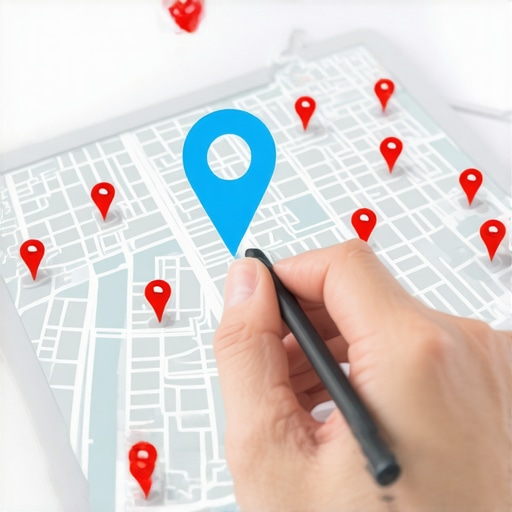
The algorithm operates on a distance weighted signal. If you are standing in a coffee shop and search for a plumber, the results you see are mathematically different than if you were two blocks away. This is the centroid theory in action. The map pin is a beacon. Every mile you move away from that pin, the signal strength decays. When you start performing a quick profile health check with a local audit tool, you see the heat map of your visibility. It looks like a target. The center is green. The edges are red. To expand that green circle, you cannot just add more keywords. You must build prominence. You must prove to the engine that you are the most authoritative entity in that specific spatial coordinate. Map spam attempts to fake this by creating dozens of listings at residential addresses. They are trying to carpet bomb the grid with fake beacons. This creates a cluttered environment where real businesses get pushed to position four. If you are stuck at map position 4, you are essentially invisible to the local user.
“Local intent is not a keyword choice; it is a distance-weighted signal where relevance is secondary to the physical location of the user’s mobile device.” – Map Search Fundamental
Why your physical address is a liability
A physical business address acts as the primary anchor for the Google Business Profile, but it also presents a significant risk for hard suspensions. Google uses internal street view data and third party verification to confirm the legitimacy of a location, often flagging shared office spaces or residential homes.
I have seen listings vanish because a building was renovated and the facade changed. The Google bot did not recognize the storefront from its last crawl. This is why proving your physical presence after a sudden location suspension is a grueling process. You need more than just a lease. You need photos of the signage from across the street. You need to show the permanent fixtures. If you are a service area business, you have a different set of problems. You have no storefront to show. You must prove your address is a legitimate base of operations. When owners are verifying a business address without a storefront, they often make the mistake of using a P.O. box or a virtual office. This is a death sentence. The algorithm identifies these footprints instantly. It compares your coordinates against a blacklist of known mail drops. One mismatch and your entire history is gone. You are left recovering from keyword stuffing or other desperate attempts to regain ground.
Local Authority Reading List
- How previous business hours affect your current rank
- The priority of citation cleanup over link building
- Defending your profile from negative search attacks
- The checklist for escaping verification loops
- What ranking software actually tells you
The forensic trace of a service area polygon
Service Area Businesses must define their geographic reach using specific polygons that do not overlap excessively with competitors to avoid being filtered. Google analyzes service area data against actual customer feedback and employee dispatch logs to ensure the business truly operates within those specified boundaries.
The map is a dispatch system. When you draw a service area on your profile, you are making a legal claim in the eyes of the algorithm. If you claim a hundred mile radius but all your reviews come from a five mile cluster, you are signaling a lie. This creates a proximity gap. I often see companies fail to track hyperlocal search proximity gaps because they use generic tools. They think they are ranking everywhere. In reality, they are only ranking where their customers actually live. This is behavioral zooming. Google tracks the movement of mobile devices that interact with your listing. If those devices never actually go to your service area, your trust score drops. This is why fighting map spam is about more than just reporting others. it is about making your own data footprint so heavy and so real that the algorithm cannot ignore it. You need evidence to prove your address that includes time stamped photos and video walk throughs. The grid does not reward the loud. It rewards the verified.
Finding the signal in the noise of fake reviews
Review spam and negative SEO attacks are mitigated by establishing a baseline of high authority local reviews that contain specific entity mentions and location data. Google uses natural language processing to identify patterns in review velocity and user account history to filter out fraudulent feedback.
Reviews are the pulse of the listing. A sudden spike in one star ratings is like a heart attack for your local rank. I have handled cases where fighting back against review attacks was a daily chore. You cannot just delete a bad review. You have to prove it is fake. This involves a forensic audit of the user profile. Does this user review things all over the world in the same hour. Do they use a VPN. If you are repairing your review history after a spam bot attack, you must be patient. The system takes time to recalibrate. Many business owners panic and try to buy good reviews to offset the bad. This is a mistake. Buying cheap feedback is poison. It leads to restoring search visibility after a severe account penalty, which is a much harder battle. Instead, focus on reclaiming lost trust through genuine customer interaction and transparency.
“A business listing is a proximity beacon verified by physical evidence and historical consistency across the local data ecosystem.” – Google Business Profile Guidelines
The physics of a localized trust score
A localized trust score is built through consistent Name, Address, and Phone data across the entire web ecosystem. This foundation is reinforced by historical data age, local link relevance, and the lack of conflicting signals in third party directories or government filings.
Trust is not an emotion. It is a calculation. The algorithm looks at your NAP data across a thousand different sources. If your phone number on a random directory from 2012 does not match your current listing, that is a conflict. This is why cleaning old citation data is the most underappreciated part of local SEO. You are removing the noise. You are making it easy for the bot to believe you. If you are standardizing your phone number across the web, you are building a shield. This shield protects you when a competitor tries to suggest an edit to your listing. If the rest of the web agrees with you, the edit is rejected. If the web is a mess of old data, the edit might be accepted. Then you wake up and your phone is not ringing because your number was changed to a competitor line. This is how businesses end up with zero phone calls overnight. It is a silent killer of local revenue.
Building a shield with clean technical signals
Technical local SEO requires a robust internal linking structure and clean content that avoids keyword stuffing or AI generated fluff. Signals from high quality local backlinks and structured data help the search engine categorize the business as a legitimate and high prominence entity.
The website and the map listing are two sides of the same coin. If your website is a mess of clean content and backlinks, your map rank will follow. Do not use spammy titles. Many owners think a clean content strategy is too slow. They want to stuff the city name into every header. This triggers the filters. It makes you look like a spammer. Instead, use a keyword research toolkit for hyperlocal growth to find what people are actually searching for in your neighborhood. Look for the specific problems they have. If you are disavowing toxic links, be careful. You do not want to cut off your own legs. Focus on building links from other local businesses. A link from the local chamber of commerce is worth more than ten links from a national blog. It proves you are part of the community. It proves you exist in the physical world.
Moving rankings across domains and physical spaces
Migrating a local business profile to a new domain or physical address requires a staggered update of all digital assets to maintain authority. The process must prioritize the transfer of historical trust signals and the reconciliation of legacy citation data to prevent a total ranking collapse.
I have seen million dollar companies disappear because they moved offices and did not handle the data properly. They changed their address on the profile but forgot the five hundred citations they built over a decade. This created a massive data conflict. If you are moving local rankings from an old domain, you must be methodical. You must maintain the link between the old brand and the new. This is the only way to transfer local authority without starting from zero. The map pin is sensitive. If it moves more than a few miles, the algorithm treats it as a new business. You lose your age. You lose your history. You might even lose your reviews if you are not careful. When updating your address without losing reviews, you must provide the proof before the change, not after. Anticipate the bot. Be ready for the suspension. Have your utility bills and your business licenses scanned and ready to go. The street photographer knows that a good photo is all about the timing. Local SEO is no different. It is about being in the right place at the right time with the right data.